
Pear Cottage Canon 760D and Tokina 11-16mm Lens, 30 Seconds Exposure ISO3200.

Equipment:Vixen ED80 and Modified Canon 550D, SkyWatcher EQ6 Mount.
Acquisition Software:Cart Du Ciel, PHD2 and APT.
Post Propcessing in Nebulosity and Photoshop with Astro Panel


I have rediscovered Astro Pixel Processor after about a year ago when I was exerimenting with a couple of 30 day free trials for this, Astro Pixel Processor(APP), and Pix Insight. At the time I opted to go for Pix Insight but have found it inaccessable especially without hours and hours spare to get in and learn how to use it. I still intend to develop skill with Pix Insight but in the meantime with the advent of free monthly downloads of image sets and a series of post processing online tutorials using APP at iTelescope I have revisted this software and feel like I have made some small progress.

Omega Centuari has a notably bright spherical ball like appearance and contains, as it's appearance suggests, millions of stars. Originally and mistakenly it was named for being the 24th cataloged star in the constellation of Centaurus (The Centaur). In this same constellation the brightest star, so named 'Alpha' Centuari (one of the two pointers to the Southern Cross), consists of a triple star system (the closest to our solar system) , a mere(cosmically speaking) and aproximate 4 light years distant or in every day terms 40 trillion kilometres hence. Omega Centauri sits 17000 light years away above the Sagittarius Arm of the Milky Way Galaxy. It is a wopping 272 light years wide a similar distance from Earth to Beta Centauri (The other Pointer Star).
Like Omega Centauri, 47 Tucanae, in past centuries, it was thought to be a star and was cataloged 47th in the constellation of Tucanae (The Toucan). Its lies 13500 light years away below the Sagittarius Arm of the Milky Way Galaxy. It is measured at a smaller 120 lightyears in width. In comparison to Omega Centauri, 47 Tucanae has a notably denser central core but petering out into the blackness of space with a less dense appearance on the periphery.
You can make sense of the relative positions in the sky of these two globular clusters, one above and one below the plain of the galaxy when we see the southern portion of the Milky Way, containing the Southern Cross and many other stars, nebulae etc, intersecting between the two objects.
References
https://en.wikipedia.org/wiki/Omega_Centauri
https://en.wikipedia.org/wiki/Globular_cluster
https://en.wikipedia.org/wiki/47_Tucanae
Sky Safari Pro 6 App Object Info


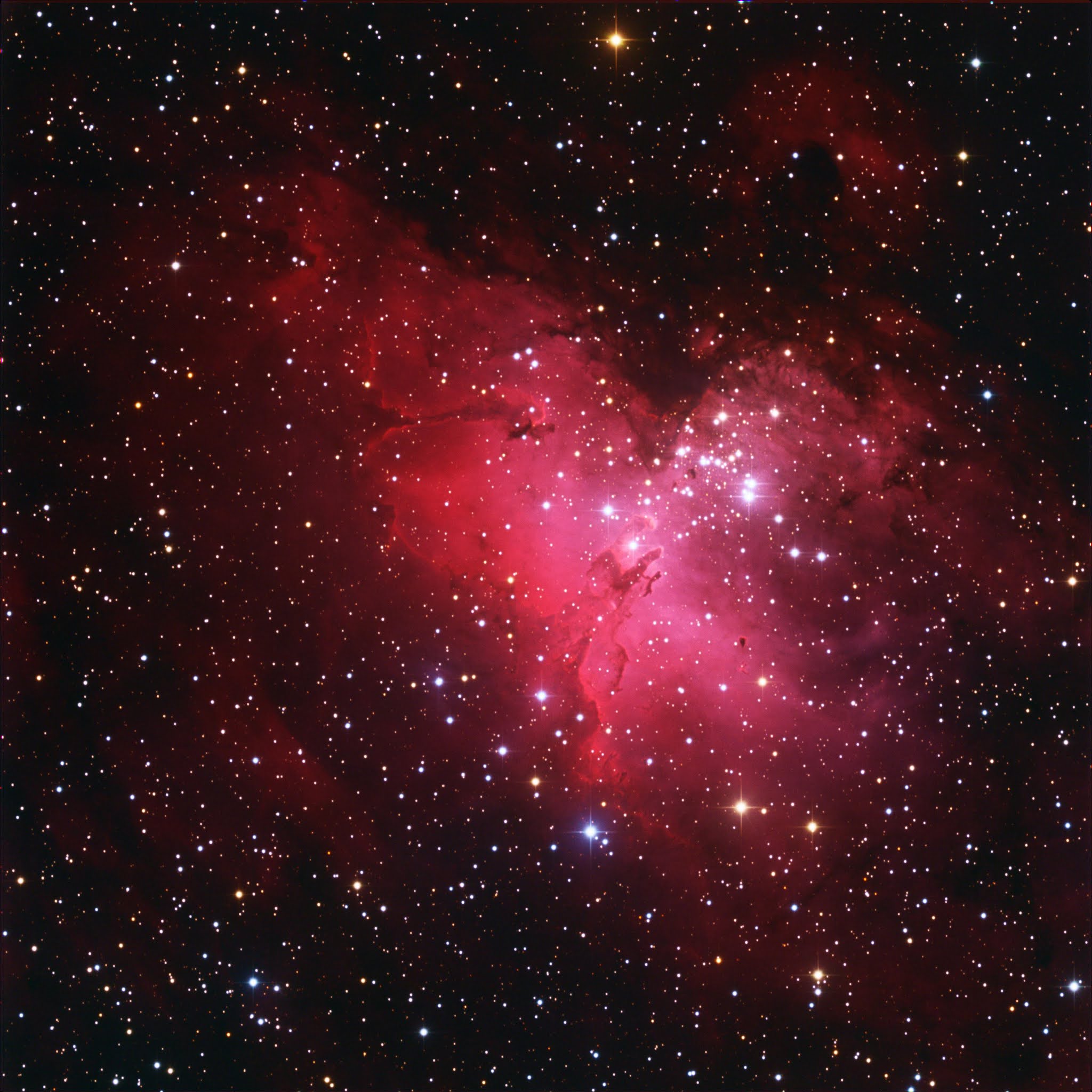
First part of a failed 2 panel mosaic with a Dual Band Filter, Ha and Oiii. 5 x 300second Exposures stacked and enhanced in post processi...


