I have rediscovered Astro Pixel Processor after about a year ago when I was exerimenting with a couple of 30 day free trials for this, Astro Pixel Processor(APP), and Pix Insight. At the time I opted to go for Pix Insight but have found it inaccessable especially without hours and hours spare to get in and learn how to use it. I still intend to develop skill with Pix Insight but in the meantime with the advent of free monthly downloads of image sets and a series of post processing online tutorials using APP at iTelescope I have revisted this software and feel like I have made some small progress.
Astronomy and Astrophotography by Michael Booth. I live in the south of Tasmania and in the breaks between the cloudy days and nights I like to get outside and enjoy observing and photographing the night sky.
Friday, October 15, 2021
Tuesday, August 31, 2021
Omega Centauri and 47 Tucanae 19th March and 1st September 2021
47 Tucanae
Omega Centuari has a notably bright spherical ball like appearance and contains, as it's appearance suggests, millions of stars. Originally and mistakenly it was named for being the 24th cataloged star in the constellation of Centaurus (The Centaur). In this same constellation the brightest star, so named 'Alpha' Centuari (one of the two pointers to the Southern Cross), consists of a triple star system (the closest to our solar system) , a mere(cosmically speaking) and aproximate 4 light years distant or in every day terms 40 trillion kilometres hence. Omega Centauri sits 17000 light years away above the Sagittarius Arm of the Milky Way Galaxy. It is a wopping 272 light years wide a similar distance from Earth to Beta Centauri (The other Pointer Star).
Like Omega Centauri, 47 Tucanae, in past centuries, it was thought to be a star and was cataloged 47th in the constellation of Tucanae (The Toucan). Its lies 13500 light years away below the Sagittarius Arm of the Milky Way Galaxy. It is measured at a smaller 120 lightyears in width. In comparison to Omega Centauri, 47 Tucanae has a notably denser central core but petering out into the blackness of space with a less dense appearance on the periphery.
You can make sense of the relative positions in the sky of these two globular clusters, one above and one below the plain of the galaxy when we see the southern portion of the Milky Way, containing the Southern Cross and many other stars, nebulae etc, intersecting between the two objects.
References
https://en.wikipedia.org/wiki/Omega_Centauri
https://en.wikipedia.org/wiki/Globular_cluster
https://en.wikipedia.org/wiki/47_Tucanae
Sky Safari Pro 6 App Object Info
Omega Centauri 
Image captured 19th March 2021, 10x60 Second Exposure, ISO 1600, Modified Canon 450D and Skywatcher EQ6 Mount. Autogided PHD Meade DSI2 Colour and 50mm GuideScope. Processed Nebulosity and Photoshop 31st August 2021.
Monday, August 9, 2021
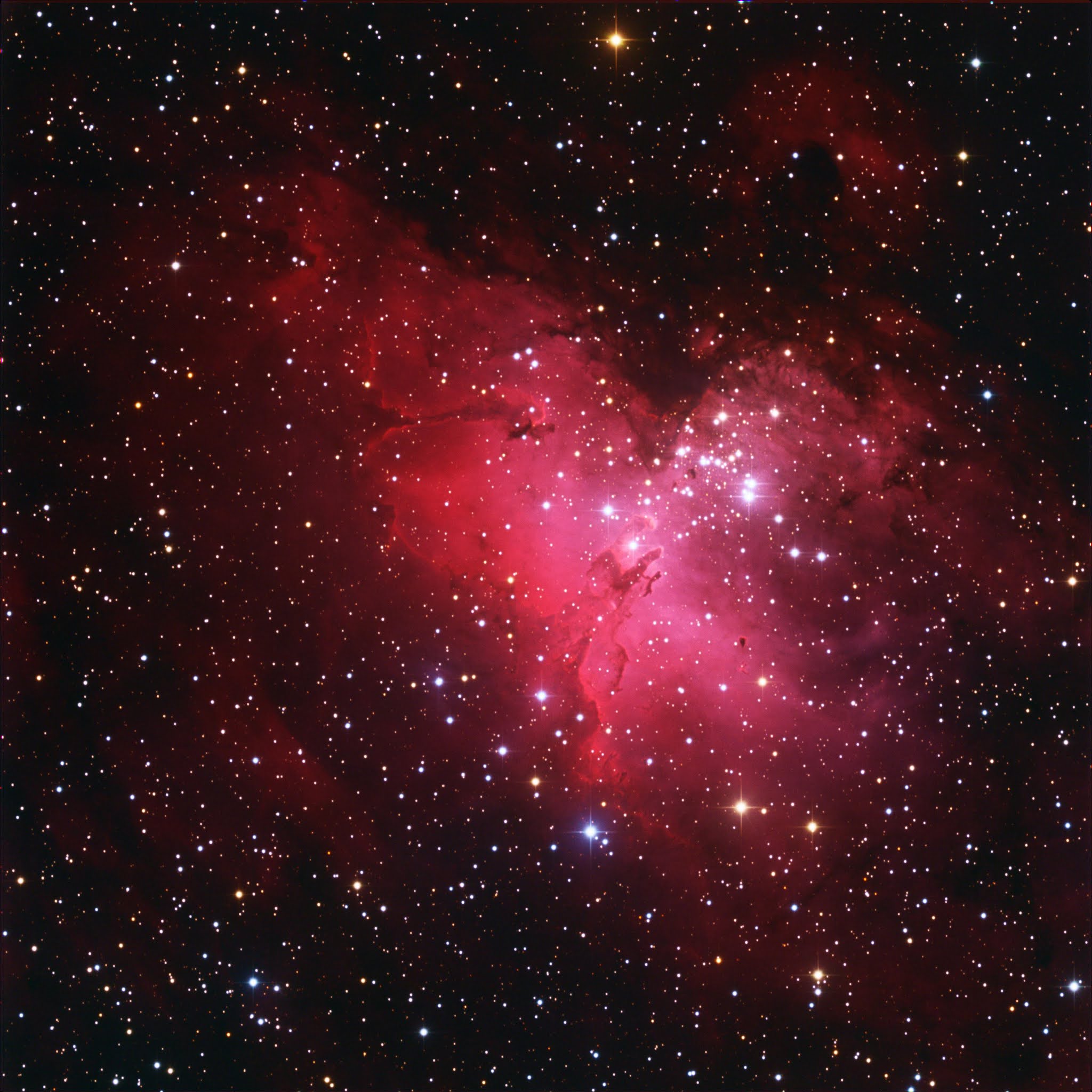
M16 The Eagle Nebula 10th July 2021

Monday, June 28, 2021
Thursday, June 17, 2021
Thursday, May 13, 2021
The Trifid and Lagoon Nebulae in the Constellation Sagittarius 12th May 2021
These remarkable nebulae are close together both within a field of view of 2 degrees and in distance from Earth (4300 light years for the Lagoon Nebula bottom right and 5200 light years for the Trifid Nebula, top left. Both are bright enough to be directly observed through the eyepiece but long exposure astrophotography and the accompanying post processing techniques make them stand out especially with the varied colour of the smaller Trifid Nebula.
Tuesday, May 11, 2021
IC 2948 The Running Chicken in Hubble Pallette Colours with further processing in Astro Pixel Processor
Second Process with preprocessing and stacking in Asto Pixel Processor and star reduction in Photoshop.
Second Process with preprocessing and stacking in Asto Pixel Processor and star removal in Photoshop.
First process with stacking in Nebulosity and combination in Photoshop
Running Chicken. T8 at Coonabarabran. Takahashi FSQ ED 106mm Refractor and FLI Monochrome Camera plus filters for Hubble Colour Pallette(HA Hydrogen Alpha, OIII Oxygen 3 and SIII Sulphur 3)Friday, April 9, 2021
NGC 6231 and IC 4628 in Scorpius
2 Images each consisting of 6 x 120 second frames stacked in Nebulosity and merged and further processing in Photoshop.
Below a wide field image of the Tail of Scorpius taken with Canon 1100D with a 50mm lens. NGC6231 and IC4628 are situated at the top and centre.
Macquarie Heads Tasmania 7th April 2021
Crux and CoalSack. 5x 60 seconds (5 Minutes) Canon1100D and 50mm Lens, tracking Vixen Polaire. Nebulosity and Photoshop.
Crux and Pointers. 5x 60 seconds (5 Minutes) Canon1100D and 50mm Lens, tracking Vixen Polaire. Nebulosity and Photoshop.
Sagittarius. 5x 60 seconds (5 Minutes) Canon1100D and 50mm Lens, tracking Vixen Polaire. Nebulosity and Photoshop.
Scorpius. 5x 60 seconds (5 Minutes) Canon1100D and 50mm Lens, tracking Vixen Polaire. Nebulosity and Photoshop. Trailing from Epsilon Scorpii (Wei), the yellow star top left, to top centre Mu1 Scorpii, top right Zeta 1 Scorpii and the star Cluster Ngc6231 and Nebula IC4628. Trailing further down the right side the yellow Eta Scorpii and then the bright white Sargas(Origins of this name now lost in time). The bottom four from right to left, Iota Scorpii, Girtab and the finally the 'Stinger' Shaula and Lasath. Girtab and Shaula form a triangle with the Globular Cluster Ngc6441. Finally two bright open star Clusters, one bottom centre Messier 7 or the Ptolemy Cluster and bottom left Messier 6 or the Butterfly Cluster. Canon 1100D with 50mm Lens. Image is a stacked combination of 5 x 1 Minute exposures tracking on a Vixen Polaire.
Sunday, April 4, 2021
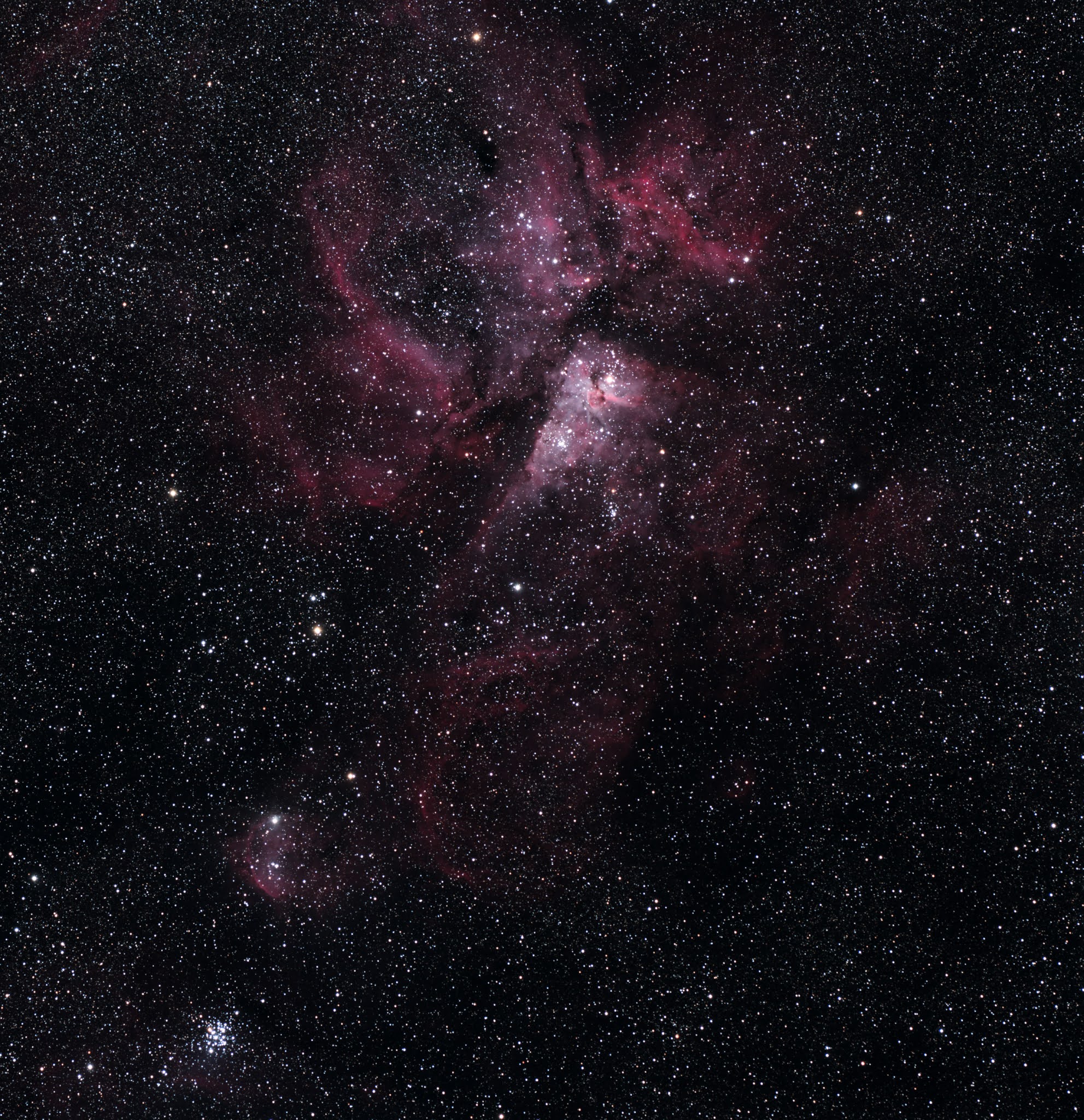
Eta Carinae Test Shot Quick Process - Post Belt Modification EQ6
Tuesday, March 23, 2021
Eta Carinae and Tarantula Nebulae and The Sprinter Cluster Tuesday 17th March
Featured Post
Crazy Chickens IC2944
First part of a failed 2 panel mosaic with a Dual Band Filter, Ha and Oiii. 5 x 300second Exposures stacked and enhanced in post processi...